
ADVANCED BODYWORK · 8 MIN READ
You got a massage. It felt good. The tension let up. You thought maybe this time it would stick.
Then a few days later, the pain was back.
Same spots. Same tightness. Like the session never happened.
Most people blame themselves. Maybe they didn’t stretch enough. Maybe they need to come in more often. Maybe they just have a bad back.
That’s not it.
About seven or eight out of ten people who come to see me with chronic neck, back, or shoulder pain have already tried at least two of the following: chiropractic, physical therapy, conventional massage, or stretching programs. Many have tried all four. The relief after a conventional massage typically lasts two to five days. Then they’re back to baseline.
That pattern has a specific structural explanation. Once you understand it, the cycle makes complete sense.
Conventional Massage Works. Just Not on the Whole Problem.
To be clear: this article is about conventional massage — Swedish massage, general deep tissue work, the kind you’d receive at a spa or a general practice. Not Advanced Orthopedic Body Therapy, which works differently and addresses a broader set of structures. That distinction is exactly what this article is about.
Conventional massage does what it’s designed to do. It reduces muscle tension. It improves circulation to compressed tissue. It calms your nervous system.
The problem is that muscle tension is only one layer of the dysfunction. The deeper layers stay untouched. And those deeper layers are what’s keeping the pain in place.
There are three of them.
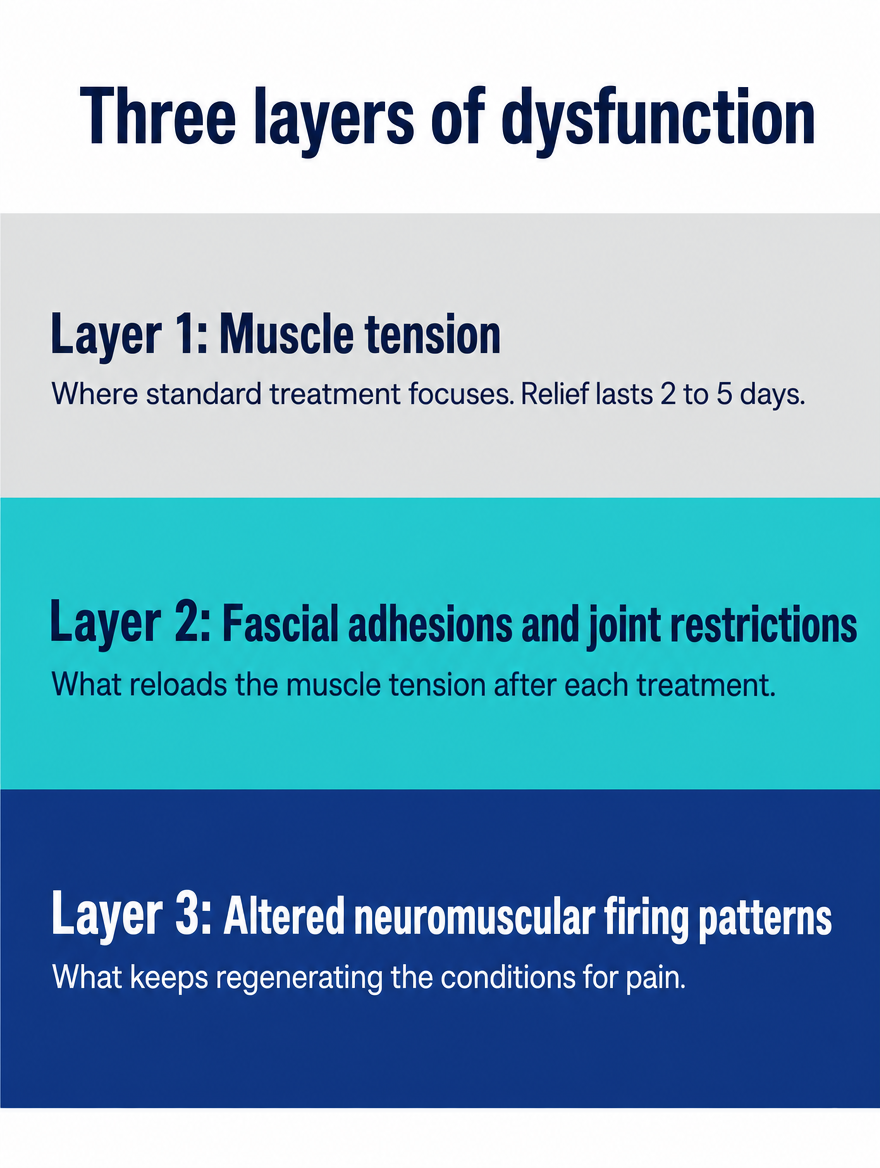
Layer 1: Your Tissue Has Adapted Around the Problem
Your body is covered in fascia. This is the thin, flexible layer of connective tissue that wraps around every muscle, joint, and organ like a continuous web.
Fascia adapts to how you use your body. Sit at a desk for years. Carry an old injury. Repeat the same movement patterns day after day. Over time, the fascia restructures itself around those stresses. It thickens, dries out, and develops adhesions.
Adhesions are spots where tissue that should slide freely has stuck together. They restrict how your muscles move. They pull on nearby joints. They create the deep, persistent tightness that conventional massage can temporarily quiet but cannot undo.
Resolving adhesions requires direct manual work on the tissue itself, at a specific depth and angle. That is a different technique from general muscle massage.
Layer 2: Your Joints Are Triggering a Reflex That Keeps Your Muscles Tight
This is the part most people have never heard of.
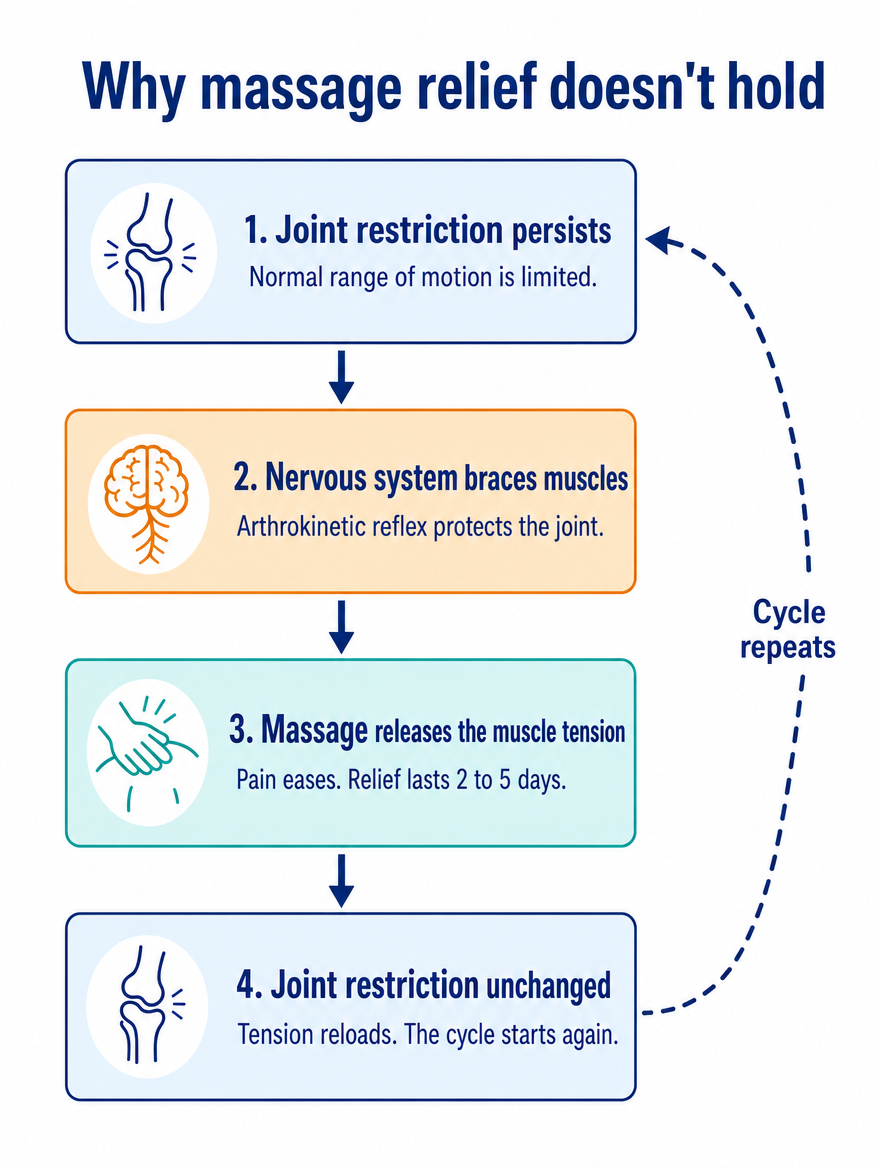
There is a neurological response called the arthrokinetic reflex. Here’s what it means in plain terms: when a joint stops moving through its full range of motion, your nervous system automatically tightens the muscles around it to protect it.
The joint isn’t working right, so your body braces it.
A conventional massage therapist can release that muscle tension. But if the joint restriction underneath it hasn’t been addressed, the nervous system will simply reload the same tension. The muscle isn’t the primary problem. The joint is.
This is partly why chiropractic can feel helpful. The joint gets mobilized and the bracing releases. But if the soft tissue around that joint isn’t also addressed, the tissue pulls the joint back out of position within days and the reflex starts over.
Layer 3: Your Brain Has Rewired How Your Muscles Fire
When your body is in chronic pain, your nervous system doesn’t just hurt. It reorganizes.
It changes which muscles it turns on. It changes the order it activates them. It changes how forcefully it fires them. This is a protective adaptation. Your brain is trying to guard the damaged area.
The part that trips people up: these altered patterns don’t return to normal on their own, even after the pain goes away. Research shows the reorganization persists long after the original injury has healed.
So the pain clears. You feel better. Life goes back to normal. But your nervous system is still running the old protective program. And that program slowly recreates the same structural conditions that caused the pain in the first place.
Pain Relief Is Not the Same as Restored Function
This is the single most important thing to understand if you’ve been cycling through treatment without lasting results.
Most people assume: if the pain is gone, the problem is solved. That’s not how the body works.
Pain fades before tissue heals. It fades before joints move correctly again. It fades before the nervous system returns to its normal firing patterns.
When pain clears and treatment stops, the dysfunction doesn’t stop. It just keeps rebuilding itself until the threshold is crossed again and the pain comes back.
There’s a specific mechanism underneath this. Chronic muscle tightness resets something called the muscle spindle. The muscle spindle is the receptor inside your muscle that tells your brain how long and how tense the muscle is. Once the spindle recalibrates to a shorter, tighter baseline, your nervous system treats that compressed state as normal and works to maintain it.
Joints that have lost normal movement stop sending accurate position signals to your spinal cord. Your brain is working with bad information about where your body is and how it’s moving.
The system is running a faulty program. That program keeps regenerating the same pain.
The Typical Treatment Journey and What Each Stop Missed
Most people who arrive at an advanced orthopedic bodywork practice have been on a version of the same path.
Chiropractic moved the joint, often with good short-term results. What it missed: the soft tissue pulling the joint back out of alignment. The fascia and muscle imbalance patterns were left intact. The adjustment holds for days or weeks, then the tissue wins.
Physical therapy prescribed exercises for strength and mobility. Sound in theory. The practical problem: you cannot effectively strengthen a muscle that your nervous system is already reflexively holding back because of unresolved tissue restriction and joint dysfunction. You’re trying to build on a broken foundation.
Conventional massage reduced muscle tension and felt genuinely helpful. What it missed: joint restrictions, deep fascial adhesions, and the altered firing patterns. It addressed the downstream symptom without touching the upstream causes.
Stretching maintained some mobility. The specific problem: stretching tissue that has adhesions can irritate rather than release it. You’re pulling on stuck tissue. Stretching without correcting muscle imbalances (some muscles chronically tight, others chronically switched off) tends to reinforce the imbalance rather than correct it.
What was missing across all four wasn’t any single technique. It was a coordinated approach that addresses all three layers together, in the right sequence.
What a Lasting Fix Actually Looks Like
Structural change requires working through all three layers in a specific order.
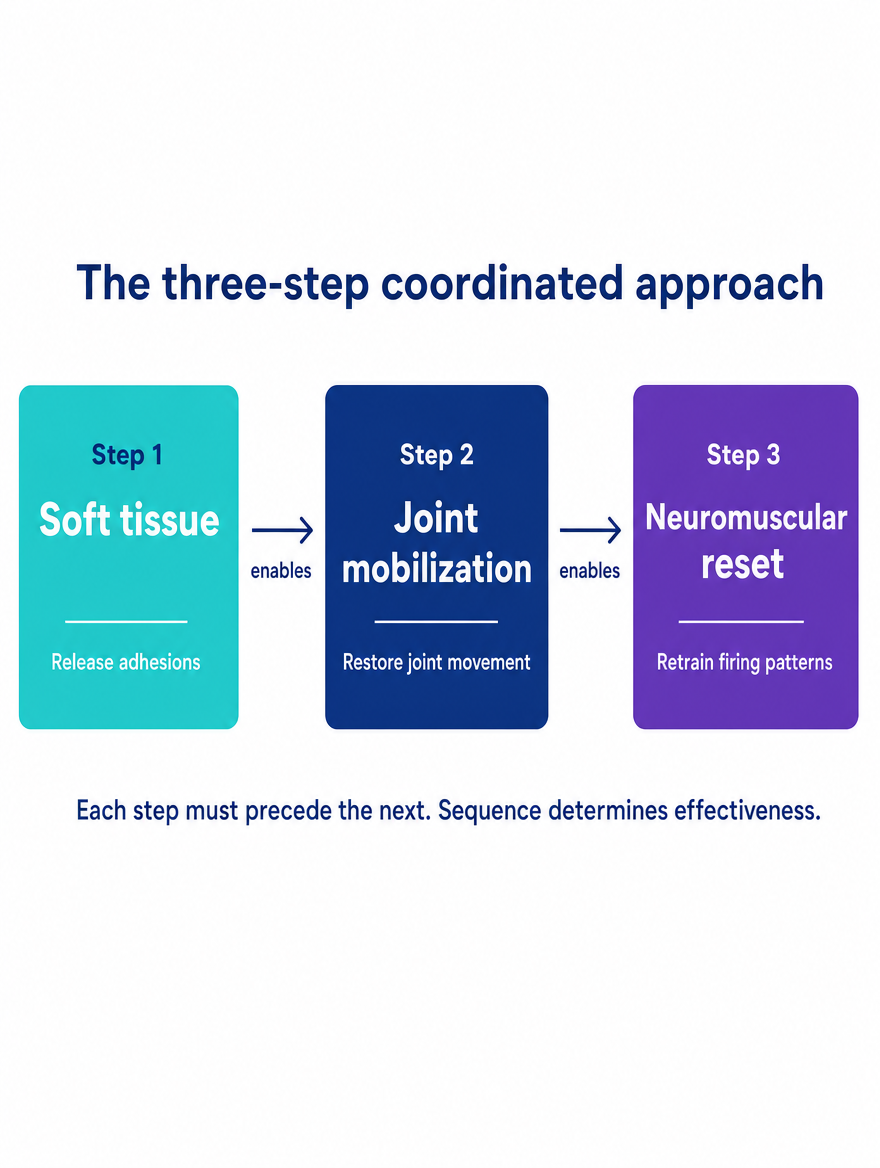
Step 1: Address the soft tissue. Direct work on the fascial adhesions and restricted tissue planes. The goal is restoring normal glide between layers and reducing the mechanical load on nearby joints. This is targeted to specific tissue structures, not general muscle work.
Step 2: Mobilize the joints. Once the surrounding tissue is released, specific mobilization techniques restore normal joint movement. This is the small-range motion that every joint needs to function correctly. It breaks the arthrokinetic reflex cycle. The joint moves freely. The nervous system releases its protective grip on the surrounding muscles.
Step 3: Retrain the neuromuscular patterns. With tissue and joint mechanics normalized, the final step is retraining the altered firing sequences. This means activating muscles that have been switched off and re-sequencing movement so load is distributed correctly. Without this step, old movement habits gradually override the structural corrections.
Each step depends on the one before it. Mobilizing a joint before releasing the surrounding tissue is less effective. Retraining patterns in a joint that’s still restricted is working against a reflex brake.
Sequence matters.
If This Describes Your Situation
If you’ve been getting relief from conventional massage but the pain keeps returning, you’re not failing to respond to care. You’re receiving care that addresses one layer of a multi-layer problem.
The right question isn’t how often you should come in or what you should be stretching. It’s whether the treatment you’re receiving is working on all three layers (tissue, joint, and neuromuscular pattern) in the right order, matched to what’s actually happening in your body.
An Advanced Orthopedic Body Therapy assessment can identify exactly which layers are driving your specific pattern and what a coordinated approach would look like.
