
Orthopedic & Therapeutic Massage · 9 min read
By Angelo dela Cruz, CAMTC-certified massage therapist and AMTA Professional Member, practicing since 1996. Former life science support scientist at NASA.
The knee that was never the problem
A man in his early fifties came in with left knee pain. No fall, no twist, no moment he could point to. It had just started feeling stiff, then slightly painful, and it hadn’t gone away.
I asked about his history. Somewhere in that conversation he mentioned, almost in passing, that he’d torn his Achilles tendon playing basketball twenty years earlier. It had healed. He hadn’t thought about it in years.
When I assessed his ankle, it had lost a significant amount of range of motion. There was dense scarring through the Achilles and real tightness through the calf. His ankle couldn’t do its share of the work when he walked, so his knee had been absorbing load it was never designed to take, every step, for years, until the tissue finally complained.
The knee was where he felt it. The ankle was where it came from.
This is the part of recovery that tends to go unaddressed. Surgery and injury heal. The incision closes, the tendon knits, the imaging comes back clean, and you’re discharged. But how well that tissue moves afterward, whether the layers still slide on each other the way they’re supposed to, is a separate question, and it’s rarely the one anyone checks.
What actually changes in tissue after an injury or surgery
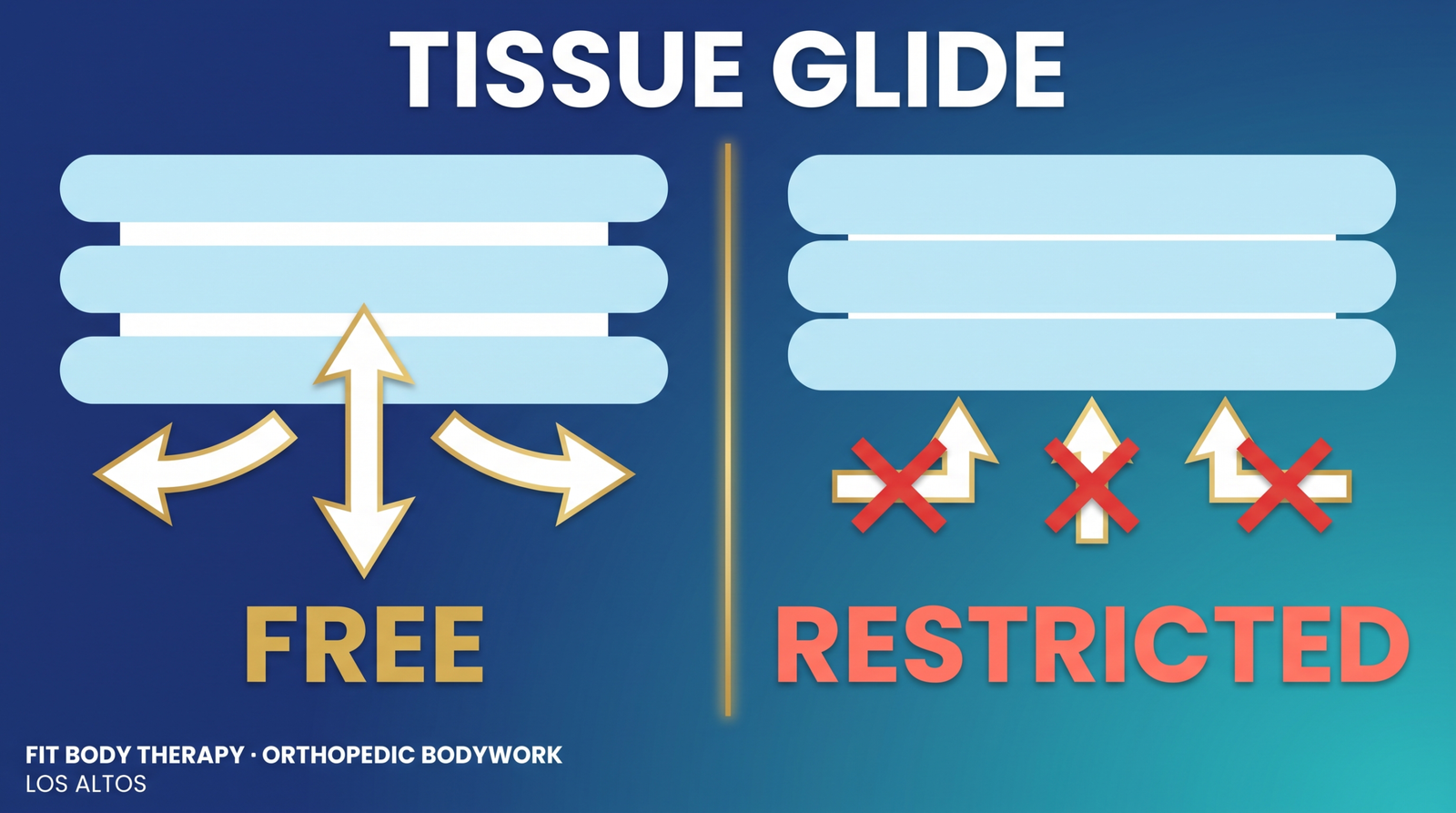
Fascia is the connective tissue that wraps and separates your muscles. In a healthy state, those layers slide against each other as you move. That sliding is what lets a joint travel through its full range without anything catching.
Injury, surgery, and long periods of not moving change that. The cascade goes something like this. Tissue is damaged. The area becomes inflamed. Loading patterns shift. Collagen is laid down as part of repair, and the interfaces between layers lose some of their ability to glide. Less glide means more mechanical stress on the surrounding structures. More stress means more pain sensitivity. More pain means less movement. And less movement means more stiffness.
It’s a loop that feeds itself. That’s why something can be quiet for two decades and then surface as a new complaint somewhere else entirely.
It’s worth separating two things that get lumped together. Densification is a change in the viscosity of the matrix between tissue layers, and it’s relatively responsive to movement and manual work. Fibrosis is a structural change in the collagen itself, and it’s more stubborn. Both reduce glide, but they don’t respond the same way or on the same timeline. It’s part of why early work is more efficient, and why a twenty-year-old scar takes longer to shift than a six-month-old one.
Reduced range of motion from scarring and immobilization is one of the better-established effects in this area. That part isn’t controversial. What people are usually told about why it happens, and what can be done about it, is where things go sideways.
What most people try first
Nearly everyone who walks into my studio with a lingering restriction has already done several rounds of deep tissue massage. Usually at whatever pressure they could stand. Close behind that: a series of chiropractic adjustments, and a photocopied sheet of stretches from a physical therapy visit six months ago.
Deep tissue does something real. Sustained pressure quiets pain sensitivity for a while. That’s a genuine nervous system effect, and people who say they walk out feeling looser are not imagining it. The effect is modest and it’s temporary, but it’s real.
What it missed, in almost every case, is that nobody assessed anything.
They pointed at where it hurt, and that’s where the hands went, for the whole hour. No one tested how the joint moved. No one checked whether the muscle was genuinely shortened or just guarding. No one asked whether the tissue generating the symptom was even in the region being worked. So the tissue actually driving the problem never got touched, and by Wednesday they’re back where they started.
That’s not a failure of massage. It’s a failure to look first.
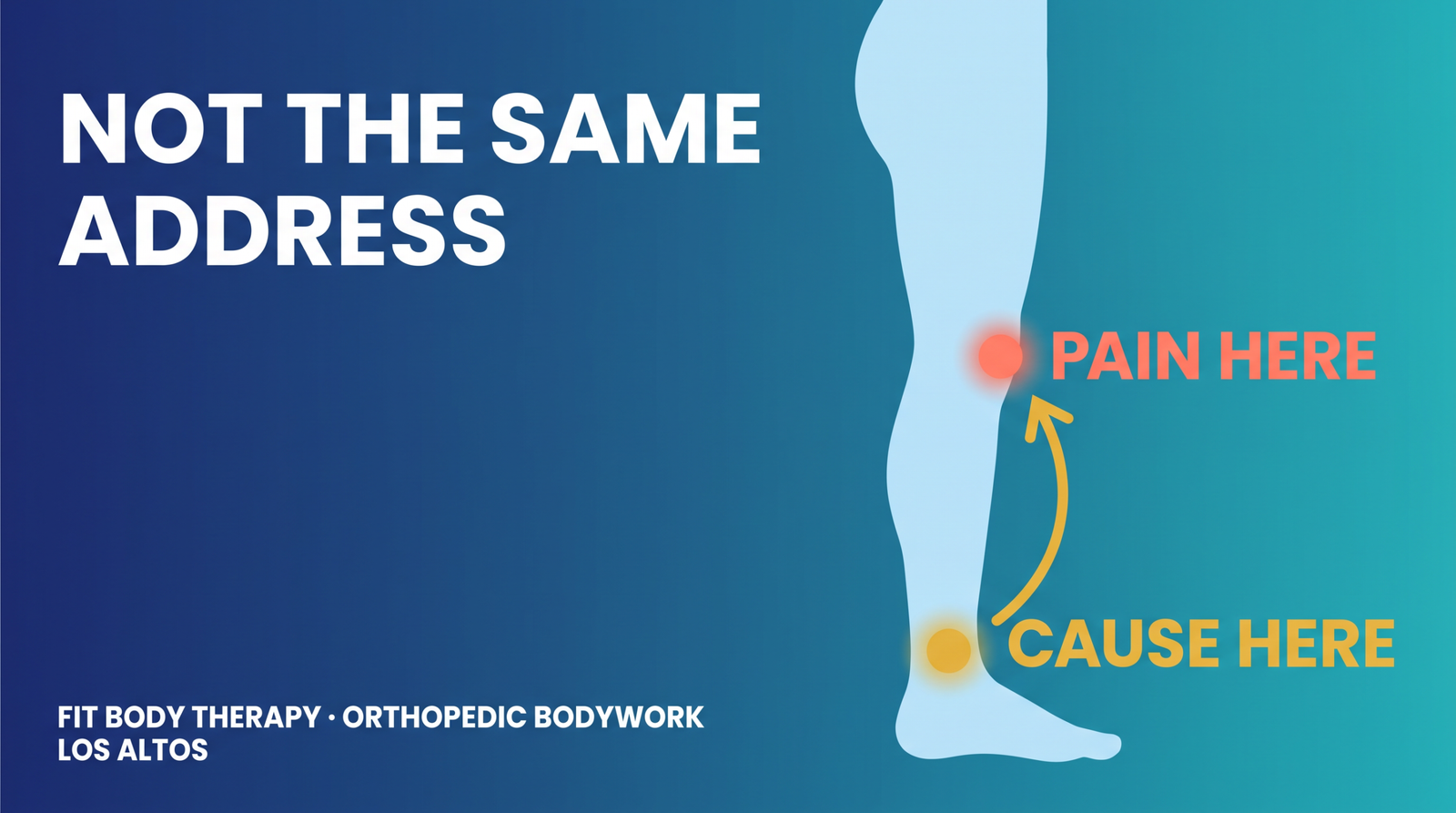
Where you feel it and where it comes from are frequently not the same address
This is the whole thing, and once you see it you can’t unsee it.
The assessment usually tells me inside the first ten minutes, and it’s less dramatic than people expect. I’ll have someone move a joint while I hold the tissue, or test a muscle against resistance, and something doesn’t behave the way it should. The end of the range feels wrong. It stops too early, or it stops soft when it ought to stop firm. Then I put my hands on the spot they’ve been pointing at, and there isn’t much there. The tissue is irritable, but it isn’t the source.
So I work back along the chain. With a leg complaint, that often means the deep hip rotators, the attachment sites around the pelvis, or segments of the low back that have quietly stopped moving. And at some point I press somewhere the person never mentioned, and they say: that’s it, that’s the thing. They didn’t know it was there. The pain was showing up downstream.
Guarding and bound tissue are not the same problem
Under the hands these can feel similar, which is exactly why they get treated the same way and shouldn’t be.
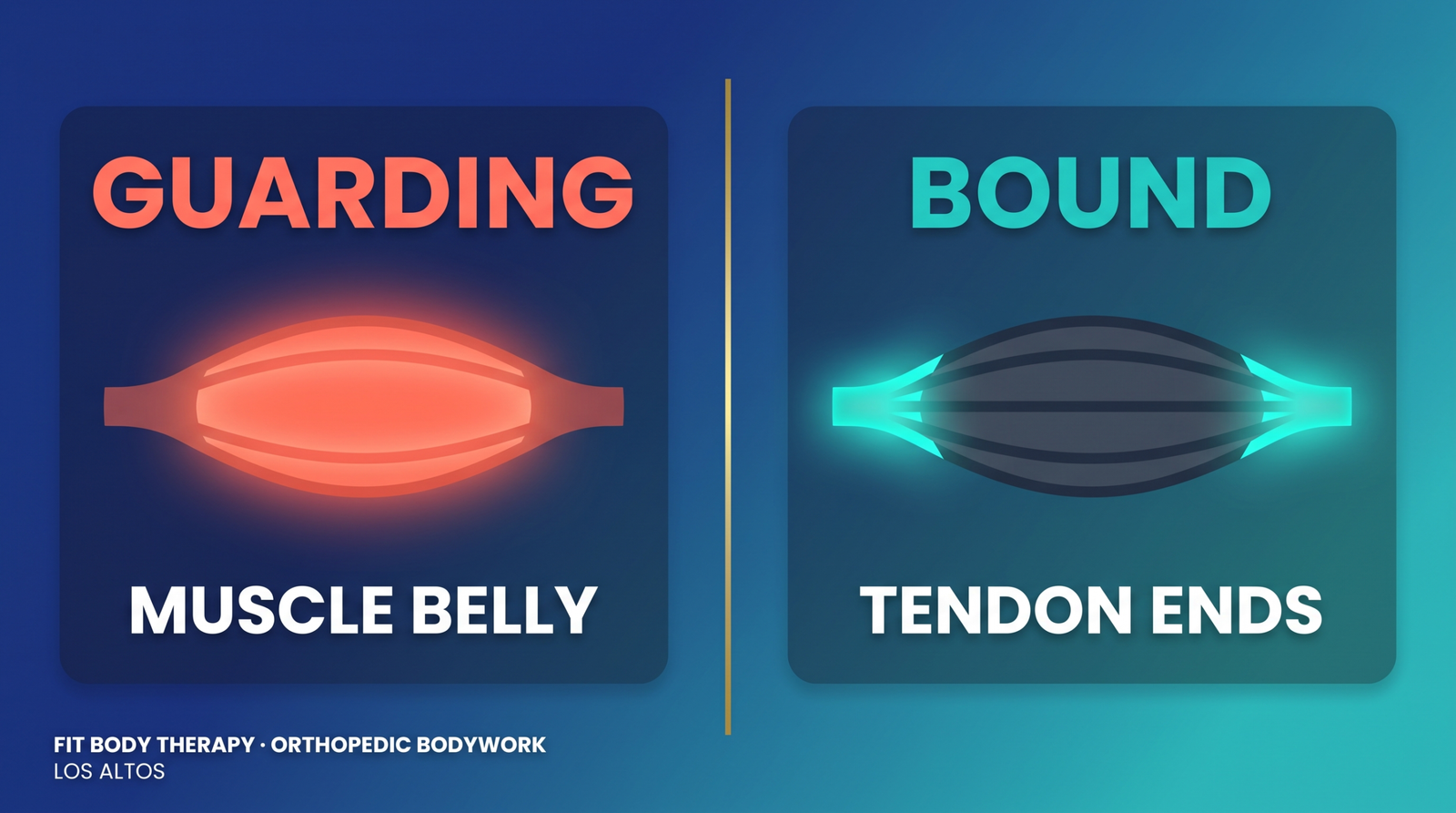
Guarding shows up in the belly of the muscle. The whole group feels taut, but there’s still movement play relative to the surrounding tissue. It hasn’t lost its relationship to its neighbors. This is the nervous system holding an area protectively because it expects trouble.
Bound tissue is different. There’s noticeably restricted movement relative to neighboring tissue, and it tends to sit near muscle-tendon junctions and bony attachments, though it can occur between tissue layers anywhere. The interface itself has stopped moving.
The distinction matters because the wrong response makes things worse. If a muscle is guarding and you drive into it harder, the guarding increases. You get a fight instead of a change. That’s the mechanism behind the most common belief I have to work against: that harder is better, that if it doesn’t hurt it isn’t working, and that soreness the next day is proof something got fixed.
It isn’t. The work I do is precise rather than forceful, and tissue lets go because it stops needing to protect itself, not because I overpowered it.
On scar tissue specifically
I’m not going to break up your scar tissue. Nobody is. Hands don’t shear mature collagen apart, and no manual technique dissolves a scar.
What I’m doing is restoring glide, getting layers that should slide on each other to slide again, and getting the joint moving so the tissue has a reason to stay that way. A 2023 systematic review of scar massage for post-surgical scars found the most commonly stated reason practitioners use it is exactly that: improving soft tissue glide. Not destruction. Movement.
What this looks like in practice
Back to the man with the knee pain.
The work went to the ankle and calf: the scarred Achilles, the tissue interfaces around the tendon junction, and the joint mechanics that had stopped participating. After the first session he had noticeably more movement through the ankle and less pressure behind the knee. I gave him specific exercises and movements to do daily. After the third session, his knee pain was gone.
Three sessions, for something that had been building for twenty years, and that no amount of work on the knee itself would have resolved.
A second case, because it ended differently and that matters.
A woman came in with knee pain she’d had for two decades, driven by chronic inflammation with substantial scarring around the joint. Her knee had been limited in both flexion and extension the entire time. We worked on the tissue around the joint and her range improved measurably.
She still needed a knee replacement. I want to be clear about that, because the honest version of this work includes the cases where structural change has gone past what hands can address. What we were able to do was improve her range and tissue mobility before surgery, and continue working with her afterward, and her recovery went better than she’d expected going in.
Improving the starting position is worth something. Preventing a necessary surgery is not a claim I’d make.
What a realistic course of care looks like
If you’re resolving something rather than maintaining it, frequency matters more than most people are told.
Two to three sessions a week would produce the fastest change. I usually suggest weekly, because for most people cost is real and a schedule you can actually sustain beats an ideal one you abandon. As the change starts holding, visits space out. Once things are stable, most people do well with maintenance around once a month.
The single biggest variable isn’t session frequency, though. It’s whether you do the exercises and movements between sessions. Every time. The people who do the daily work make significantly more progress than the people who rely on the table alone, and it isn’t close. Manual work opens a window. Movement is what keeps it open.
One session rarely holds on its own, not because the work failed, but because the pattern that produced the restriction is still running. Tissue stiffness is modifiable, which is the good news. It’s also re-creatable, which is why the homework matters.
If a restriction hasn’t resolved
If you’ve had surgery or an injury and something still doesn’t move the way it used to, or if pain has shown up somewhere that never got hurt in the first place, it’s worth having someone actually assess it rather than treat the spot that hurts.
That’s the work I do with orthopedic massage in Los Altos, CA, serving Los Altos, Mountain View, Palo Alto, Sunnyvale and the surrounding Peninsula. Every session starts with assessment: history, watching you move, testing the joints, testing muscles against resistance, and palpating for what the tissue is actually doing. That determines where I work, and it’s frequently not where you’d have asked me to.
This isn’t the right tool for everything, and I’ll tell you when it isn’t. If you want to relax for an hour, a good Swedish massage is the better call. And if what I find in the assessment isn’t a soft tissue problem, I’ll say so and point you toward someone who can help.
Common questions
Can massage break up scar tissue?
No. Hands can’t shear mature collagen apart, and no manual technique mechanically dissolves a scar. What changes is how well the tissue slides against what’s next to it, how sensitive the area is, and how much load it tolerates. A 2023 systematic review of post-surgical scar massage found the most commonly stated goal was improving soft tissue glide, not destroying tissue. Better glide is why a scar starts moving and hurting less.
When is it too late to massage scar tissue?
Later than most people are told. Scars remodel most actively in the first year, so earlier work is more efficient, but tissue stiffness stays modifiable well beyond that. I’ve worked with twenty-year-old scarring in an Achilles tendon and twenty years of scarring around a knee, and range improved in both. An old scar isn’t a fixed structure you missed your window on. It responds more slowly, not never.
How long after surgery can you massage scar tissue?
Only once your incision is fully closed, free of scabs, and your surgeon has cleared you. That’s commonly somewhere around two to four weeks, though the timeline belongs to the person who performed your surgery, not to a general rule. Incision type, location, and how you’re healing all move it. Get the clearance first.
Is myofascial release better than massage?
Neither is better. They’re aimed at different problems. A general massage session is built around whole-body tension and relaxation. Myofascial work is targeted: assess which movement is restricted, find where the tissue isn’t sliding, work that interface, retest. If your goal is to feel looser for the afternoon, either works. If a specific motion has been limited since an injury or surgery, the targeted version is what addresses it.
Why is myofascial release painful?
Often it isn’t, and when it is, the reason matters. Some discomfort is tissue being loaded near its current limit. But much of what people feel is guarding, protective muscle tone the nervous system generates because it expects the area to hurt. Guarding can feel like bound tissue under the hands. Forcing through it usually increases it. Working at an intensity the system tolerates is what allows it to let go.
How often should you get myofascial release?
While resolving something, two to three sessions a week produces the fastest change. Weekly is the more sustainable version most people choose. As results hold, visits space out, and most people settle into maintenance around once a month. Daily exercises between sessions make a larger difference than session frequency does.
Fit Body Therapy · Orthopedic Bodywork · 600 Fremont Avenue, Los Altos, CA 94024
