
CHRONIC PAIN & MYOFASCIAL RELIEF · 9 MIN READ
You stretch every morning. Maybe you foam roll after workouts. You’ve probably held a few yoga poses hoping something would finally let go. And for a few minutes, it feels like progress.
Then an hour later, you’re just as tight as you were before you started.
If that’s been your experience, I want to tell you something that might be a relief to hear: you’re not doing it wrong. You’re using the right tool on the wrong problem. Static stretching is built to lengthen a muscle in one line, one direction, one plane of motion. Tight fascia isn’t a one-direction problem, and that mismatch is the entire reason it doesn’t resolve the way you’d expect.
I’m Angelo dela Cruz, founder of Fit Body Therapy here in Los Altos. I’ve practiced advanced orthopedic and restorative bodywork, including hands-on myofascial release, since 1996. This piece is about what fascia actually is, why it gets tight in a way stretching can’t reach, and what a coordinated approach to myofascial release does differently.
Why Fascia Gets Tight in a Way Stretching Can’t Fix
Fascia is the connective tissue that wraps every muscle, organ, and joint in your body in a continuous, three-dimensional web. It’s not just packaging. It’s designed to glide — layers sliding smoothly against each other so you can reach, twist, and rotate without resistance.
When fascia loses that glide, two things are usually happening at the tissue level, and neither one is complicated once you picture it.
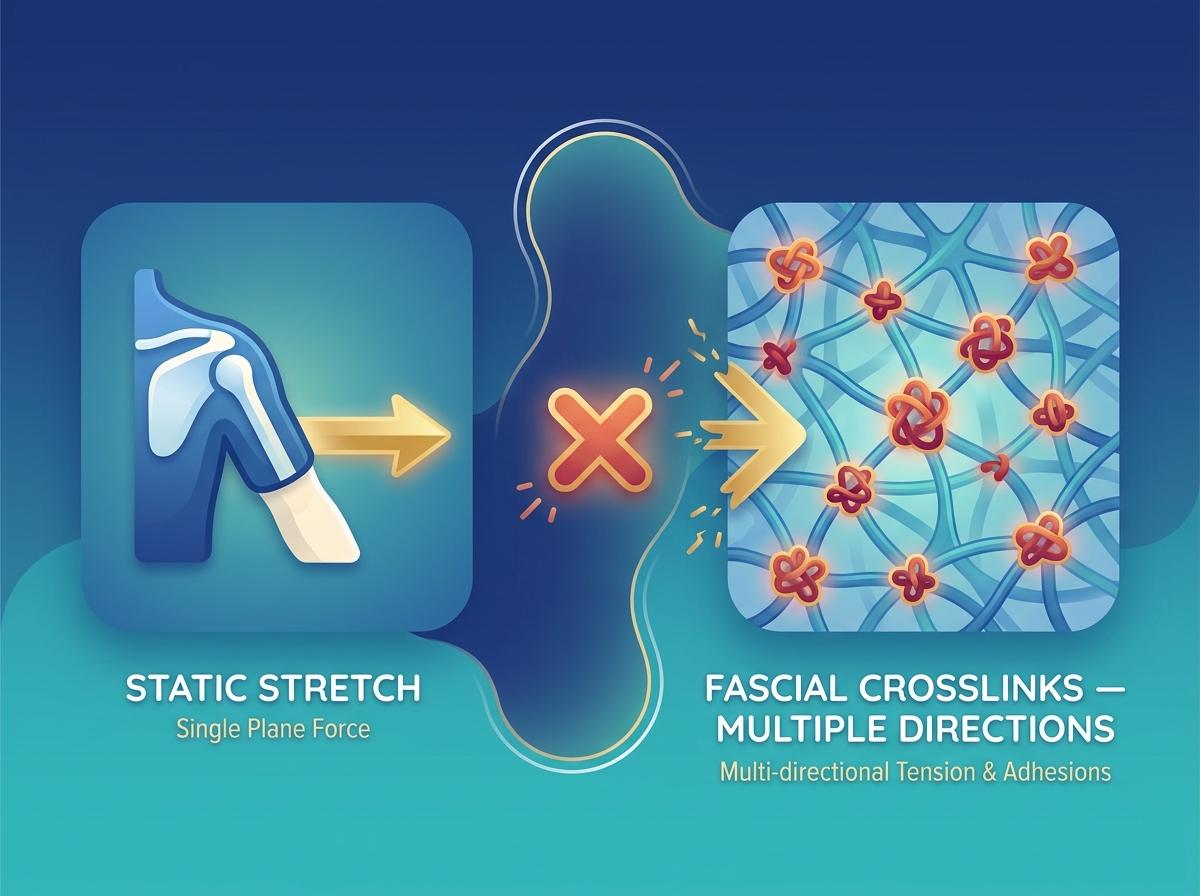
First, fibers that are supposed to slide past each other start sticking together instead — doctors call this an abnormal crosslink, but think of it like two pieces of tape that got pressed together and now won’t peel apart cleanly. That stuck-together spot is what’s actually called a fascial adhesion.
Second, the gel that fascia’s fibers normally float and slide around in — its technical name is the extracellular matrix, but you can just think of it as “the goo fascia sits in” — can thicken up. It goes from something slippery, almost like olive oil, to something thicker, more like honey that’s been left in the fridge. Tissue sitting in that thicker goo resists movement in every direction, not just one.
Here’s why that timing matters: early on, that thickened “goo” stage is a bit like clay that’s still wet — it’s stiffer, but it’s still workable, and it can loosen back up if you keep moving it. The longer it’s left alone, though, the more it can turn into something closer to clay that’s already been baked hard in a kiln — a real structural change that’s much tougher to undo. That’s part of why one deep-tissue session was never meant to be the whole plan. Moving afterward is what keeps the tissue soft and workable instead of letting it harden back into the same shape.
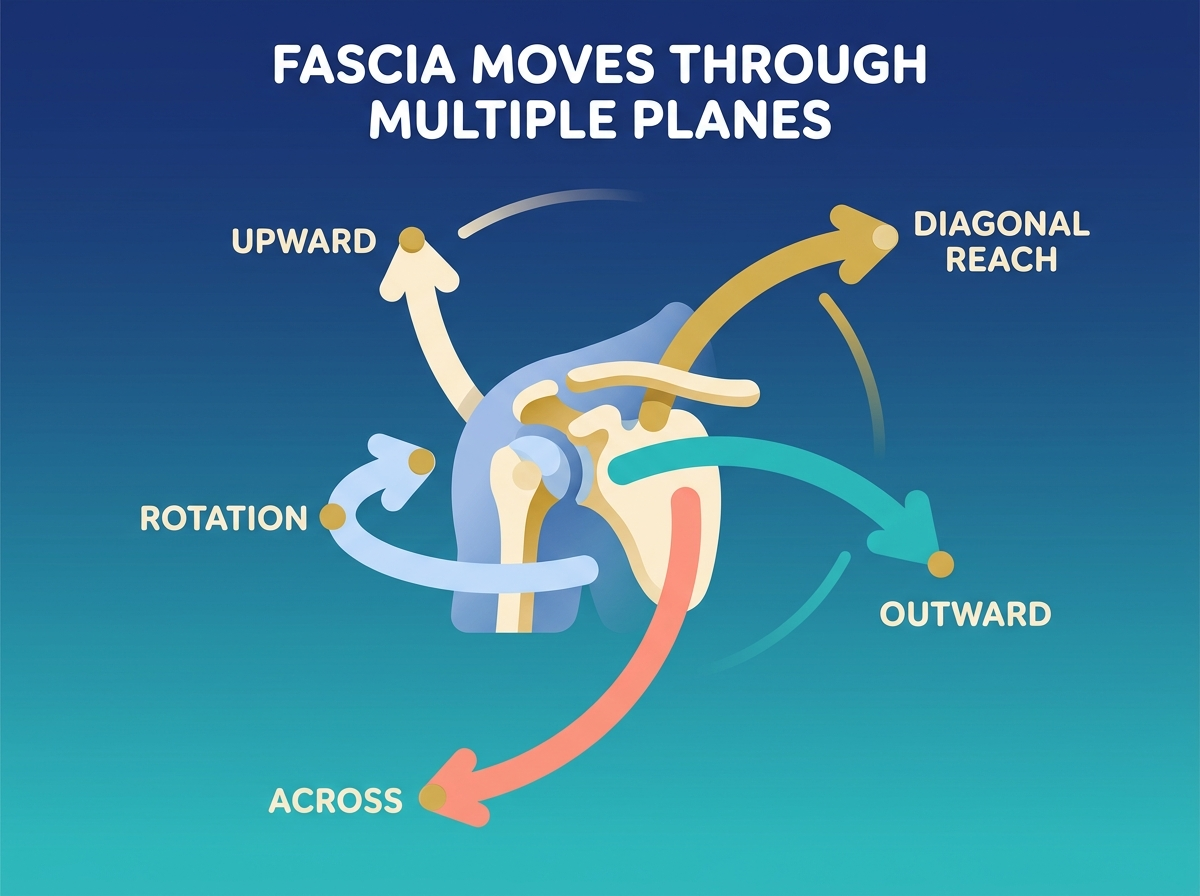
Here’s the part that explains why stretching alone falls short: fascia is built to move in more than one direction at the same time — not just stretch out in a straight line, the way a rubber band does. A shoulder doesn’t just bend and straighten; it also twists, swings out to the side, and reaches across the body at an angle — all in one single reach. The stuck spots and thickened goo build up in all of those directions too, not just one. A static stretch only pulls in roughly one direction — like tugging one corner of a blanket. It can’t reach, let alone loosen, a stuck spot sitting in a direction that tug never touches.
This is also why the same tight spot can come back within days of a massage or a stretching session that genuinely felt good in the moment. The tension eases in the direction that was addressed. The crosslinks in the other directions never moved.
What Most People Try — and Why It Only Gets Partway There
I’ve had many clients who exercise regularly, have been through physical therapy or chiropractic care, and stretch and foam roll consistently — and they still come to me because none of it has worked as well as they’d hoped. It’s rarely a lack of effort. It’s usually the same gap: static stretching, foam rolling, and general massage all share the same limitation. They work in a single plane of movement, repeated in the same line, session after session.
That’s not a criticism of the habit — it’s a genuinely reasonable thing to try, and it isn’t wrong to do. It helps blood flow, it can calm down your body’s automatic tensing-up response (the same reflex that makes you flinch), and it feels like you’re taking action. The issue is what it can’t reach. Stuck spots that formed in more than one direction need to be loosened in those same directions — and a straight-line stretch, repeated the same way every time, simply can’t undo something that isn’t a straight-line problem.
This is the piece that’s easy to miss: the tissue you’re trying to release was never designed to move in just one direction, so releasing it in just one direction was never going to be the whole answer.
The Key Insight: True Release Happens Across Multiple Angles, Then Gets Used
If a client asked me point-blank why stretching doesn’t just fix this, here’s the honest answer: because most stretching only moves in one straight line, and it doesn’t cover the multiple directions the tissue is actually built to move through. Releasing tight fascia in a way that lasts means working it from different angles — not one line, repeated — so the stuck spots actually let go in every direction, and the fascia can glide freely everywhere it’s built to move, not just the one direction you happened to stretch.
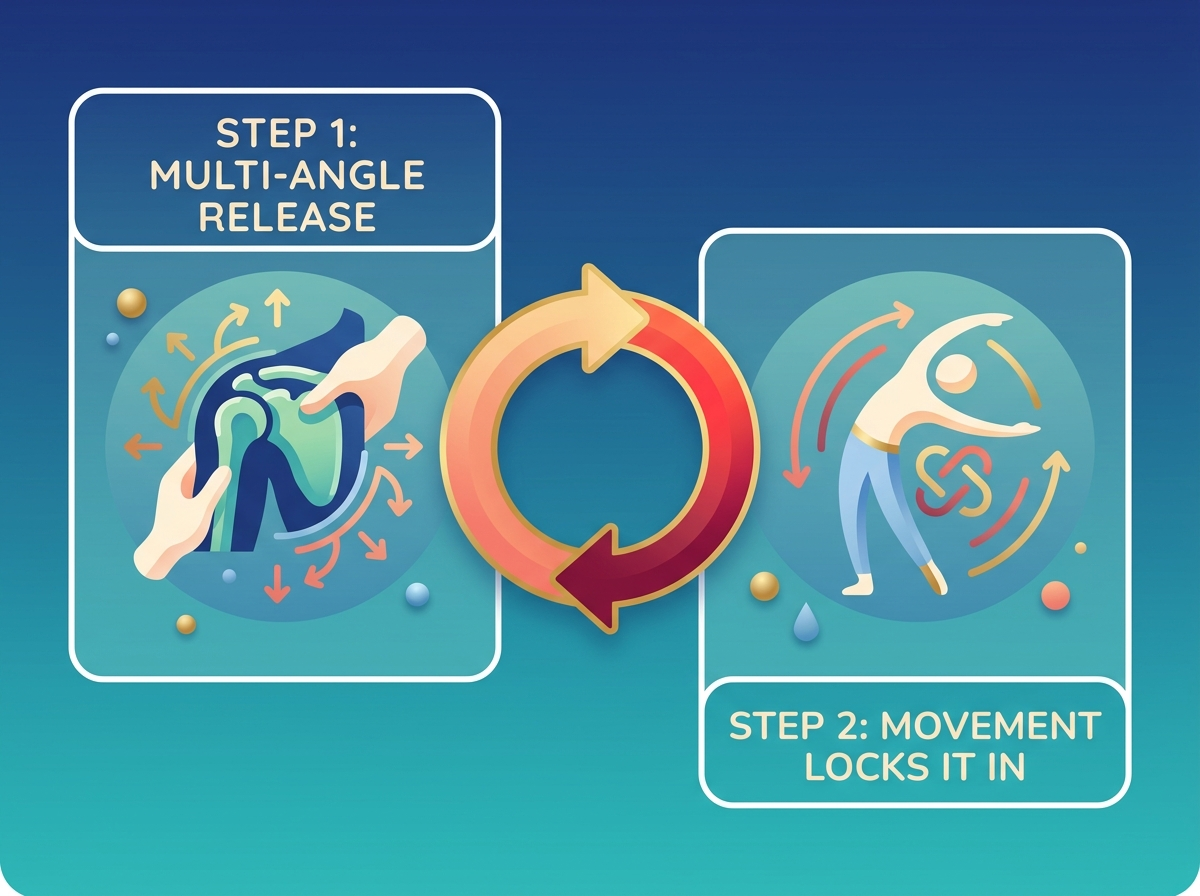
But release is only half of it. Fascia doesn’t stay in its new, freer state just because it was worked on. The health of fascia is ultimately dependent on movement. Once a restriction is released, your body needs a reason to keep using that new range — otherwise the tissue tends to drift back toward the pattern it knows, simply because that’s the pattern it’s used most. That’s why lasting fascial health depends on two things working together: hands-on release that reaches multiple planes, and movement and corrective exercise afterward that actually uses the range you just gained.
Skip the second half, and the first half’s benefit fades. That’s the real reason “the tightness came back” — not because the work didn’t hold, but because nothing after the session gave the tissue a reason to keep the new range it had gained.
What This Actually Looks Like in a Session
In practice, addressing fascia from multiple angles doesn’t look like one long stretch held for two minutes. It looks like changing your position on the table, spreading the tissue in different directions by hand, and moving the joint itself through different planes while the tissue underneath is being worked — rotating a shoulder through its own arc while addressing the fascia around it, for example, rather than pulling on it in a single line from a single position.
That combination is deliberate. Moving the joint through its natural planes while working the tissue lets the fascia release in the actual directions it’s designed to move through — not just the one direction a stretch would pull it in.
Worth knowing: not everything that feels “tight” is actually shortened tissue. Sometimes your body is just protecting the area on purpose — the same automatic “guarding” your hand does right before you touch something you think might be hot. Under my hands, that protective tension can feel exactly like a real stuck spot, but it doesn’t loosen the same way force does on a genuine adhesion. Telling the two apart, and working with the body’s defense instead of fighting it, is part of why this isn’t about pressing as hard as possible.
Afterward, the work isn’t finished at the table. Depending on what we’ve released and where, that often means specific corrective exercises or movement patterns designed to put the new range of motion to use — so the nervous system and the tissue itself start treating that range as the new normal, rather than something to drift away from.
A small but telling sign this is working: noticing you can reach into the back seat, or turn to check a blind spot, without the familiar catch — not because you stretched into it, but because the tissue itself moves differently now, in more than one direction.
What Becomes Possible Once Fascia Actually Glides Again
The goal was never just “less tight.” It’s tissue that moves the way it’s supposed to — in every plane it was built for, not just the one you’ve been stretching.
For most people, that looks like reaching, rotating, and moving without a mental note of where you’ll feel resistance. It also means the exercises you’re already doing — whether that’s a physical therapy protocol or your own workout — finally have room to work. If fascia around a joint is restricted, that joint has a hard ceiling on its range no matter how faithfully you do the exercise; you can strengthen a muscle right up to that ceiling and never past it. Release the restriction first, and the same exercise you were already doing can produce real, visible progress instead of the same plateau. And a body that holds onto the range you’ve gained, because you’re using it — not just hoping it sticks.
Think of this less as being “tougher” and more like a rope that can hold more weight before it frays — the technical term is load tolerance, but really it just means how much your tissue can handle before something gives out: the sudden reach, the awkward step off a curb, the heavier lift.
Research on myofascial release methods, including a systematic review of randomized controlled trials and a randomized, placebo-controlled trial on lumbar tissue microcirculation, supports what shows up in the treatment room: targeted, hands-on work on fascial tissue produces measurable changes that a generic stretch does not.
If This Is You
If you’ve been stretching faithfully and still feel tight in the same places, the tissue isn’t failing to respond to effort. It’s responding exactly the way fascia responds to a single-direction input — partially, and temporarily.
An assessment with a myofascial release specialist in Los Altos who works across multiple planes — not just one stretch, repeated — can identify exactly where your fascia has lost its glide and in which directions. There’s no pressure here and nothing to decide today. When you’re ready to talk through what’s going on in your body, you can reach out through the contact page and we’ll go from there.
Frequently Asked Questions
Why doesn’t stretching fix tight fascia?
Stretching only pulls in one direction, like tugging one corner of a blanket. Fascia gets stuck in many directions at once, so a stretch that only works in one line can’t reach — or loosen — a stuck spot sitting in a direction that stretch never touches.
What actually causes fascia to feel tight?
Two things: fibers that should slide past each other start sticking together instead (like two pieces of tape pressed together), and the gel those fibers normally float in gets thicker, more like honey left in the fridge than a slippery oil. Together, these make the tissue resist movement in every direction, not just one.
How is myofascial release different from a regular massage or foam rolling?
Regular massage and foam rolling typically work in one direction, over and over. True myofascial release works the tissue from multiple angles — changing body position, moving it in different directions by hand, and moving the joint through its own range while the tissue is being worked — so the stuck spots get addressed in every direction they formed in, not just one.
Does releasing tight fascia hold, or does it come back?
It holds better when release is paired with movement. Fascia’s health depends on ongoing use of the range that’s been restored — corrective exercises and movement patterns that put the new range to work. Release without follow-up movement tends to drift back toward the old, tighter pattern simply because that’s the pattern the tissue is used to.
This article is for educational purposes and is not a substitute for individualized medical advice. If you have a medical condition or new or severe symptoms, please consult a qualified healthcare provider.
